GyanGram Turning UPSC preparation from scattered study into a guided mastery journey.
A Flutter-based UPSC prep app where every card, article, and PYQ feeds a live mastery map of your exam preparation. Built entirely solo: design, code, content, and systems, using AI-augmented workflows.
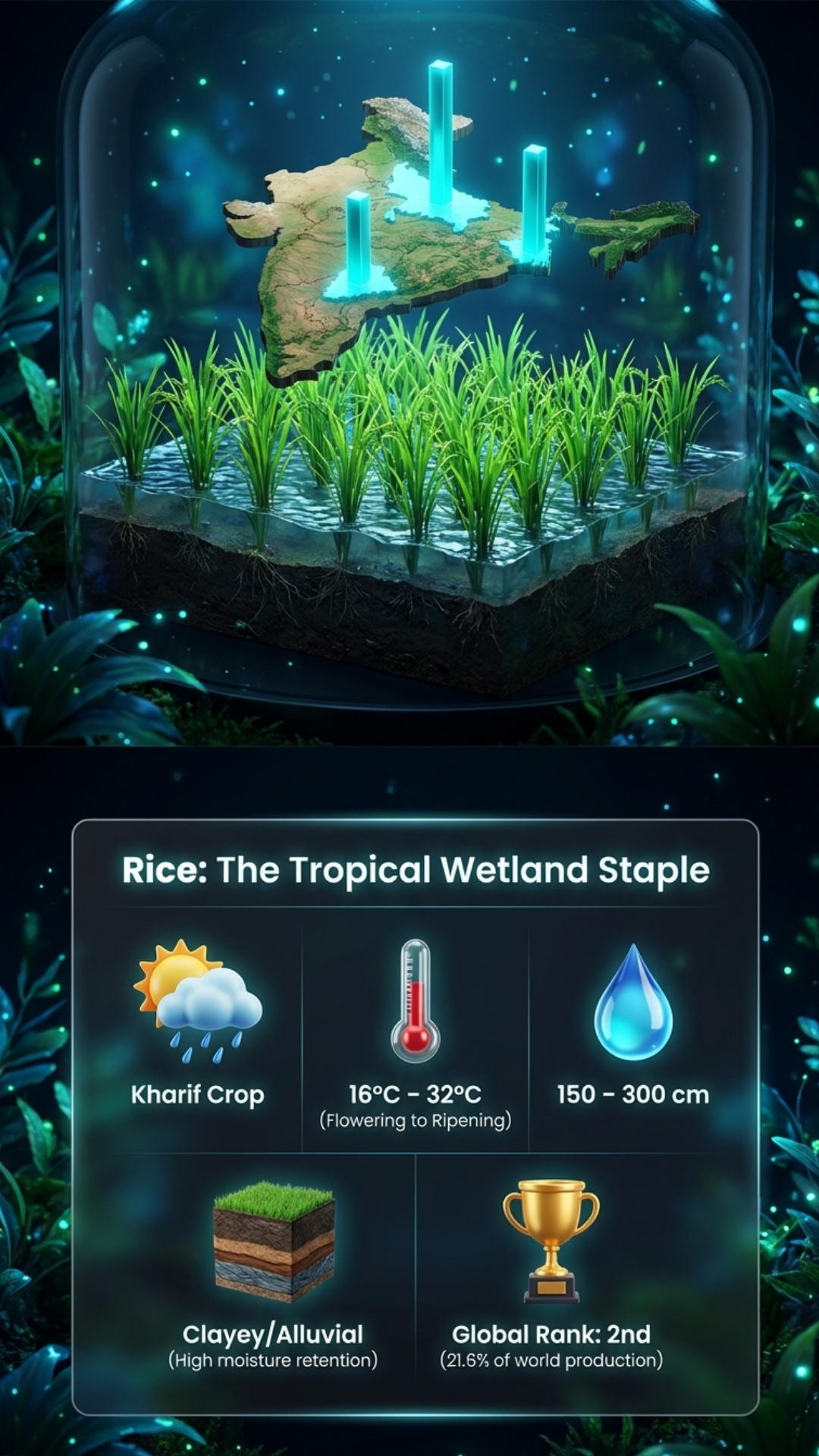
One thought while scrolling a slide deck.
In early 2025, I was scrolling through a NotebookLM slide deck. A thought struck: millions of UPSC aspirants scroll through Instagram and Reels every day — what if that exact scroll behaviour led to learning instead of entertainment?
That question, shared with Claude in a conversation, became GyanGram. The idea was deceptively simple: convert the behaviour, don't fight it. But building the product revealed the real problem — and it wasn't what the original idea assumed.
"UPSC aspirants don't fail because they lack content. They fail because they don't know what they actually know."
— The insight that changed the product from a content feed into a learning system
India has infinite UPSC content. That is not the problem.
YouTube channels, PDFs, printed notes, coaching videos — UPSC aspirants are surrounded by content. They still fail. Because content access was never the gap.
No live picture of mastery
Aspirants read topics but have no way to know whether they've actually learned them or just seen them. Passive reading feels productive. It isn't.
Social media wins the same screen time
A 30-minute free window ends up on Instagram, not study. The phone is the problem and the solution. GyanGram bets on using the behaviour, not fighting it.
Revision is broken
Most students never return to what they studied. Notes are written and forgotten. Wrong PYQs are accepted and repeated. There's no system driving them back to weak areas.
Heavy formats for a short-attention era
3-hour video lectures and 200-page PDFs are designed for a different generation of learners. Most aspirants today study in fragments — apps and commutes and lunch breaks.
The honest version — how Version 1 became what GyanGram is now.
The first version had three tabs: Home, Explore, Profile. Explore was a scroll feed. The app existed. But it had no reason for users to return.
"Why would a user keep coming back to this app?"
— The question that turned a content feed into a learning system
The answer: only if the app showed them their progress and told them what to do next. That question led to the Learn tab as a syllabus mastery map and the Home tab as a daily coach — not a generic dashboard.
Three more pivots followed, each driven by a real problem hit during building:
The image pivot
Early cards were AI-generated images. Beautiful — but fragile. One wrong fact required a completely new image. No searchability as content scaled. I researched Flutter's widget rendering and built ~50 reusable card templates. Now a JSON file creates an entire card deck in seconds. AI images remain for creative visuals where precision matters less than impact.
The depth discovery
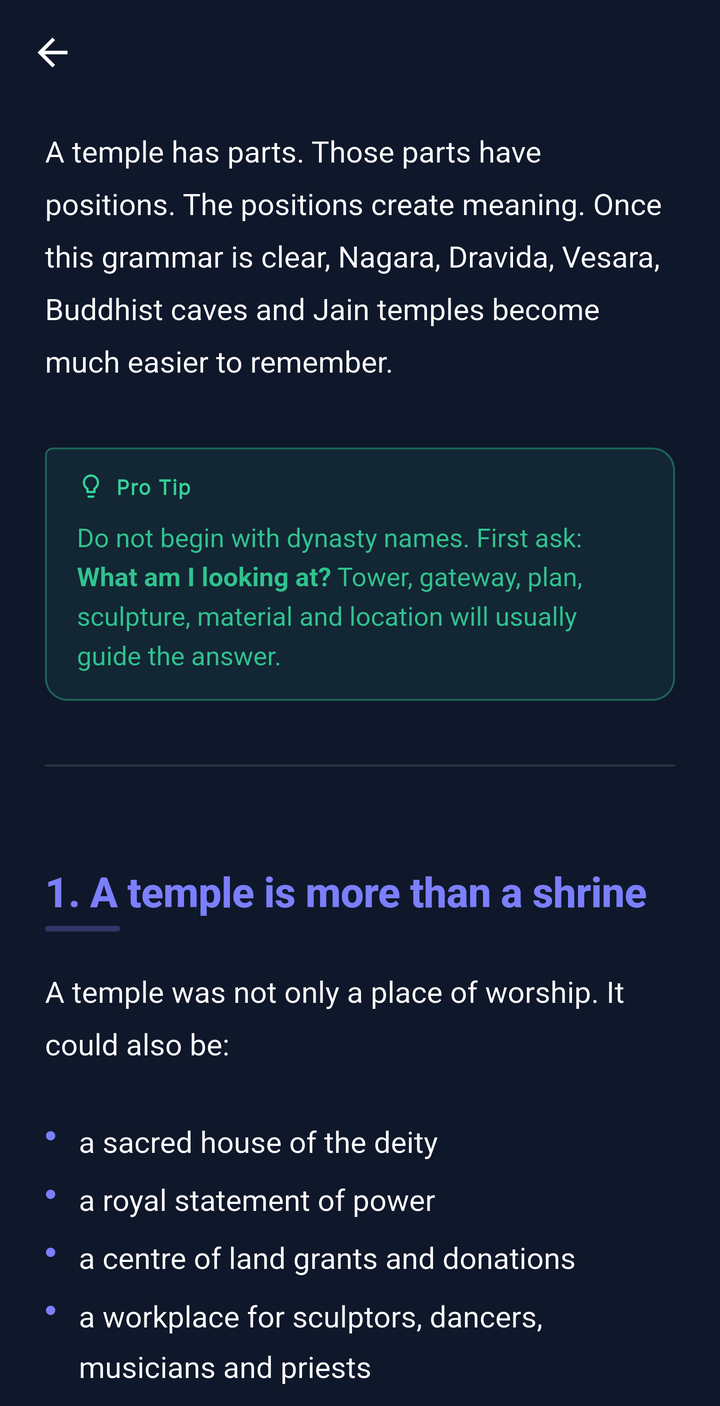
Cards teach facts. Articles teach understanding. I built an interactive markdown reader and linked articles to cards via long press — the aspirant can go deep on any concept, then return to the card stream. Two-layer learning: quick recall plus deep comprehension. That pairing is what UPSC Mains actually requires.
The mastery architecture
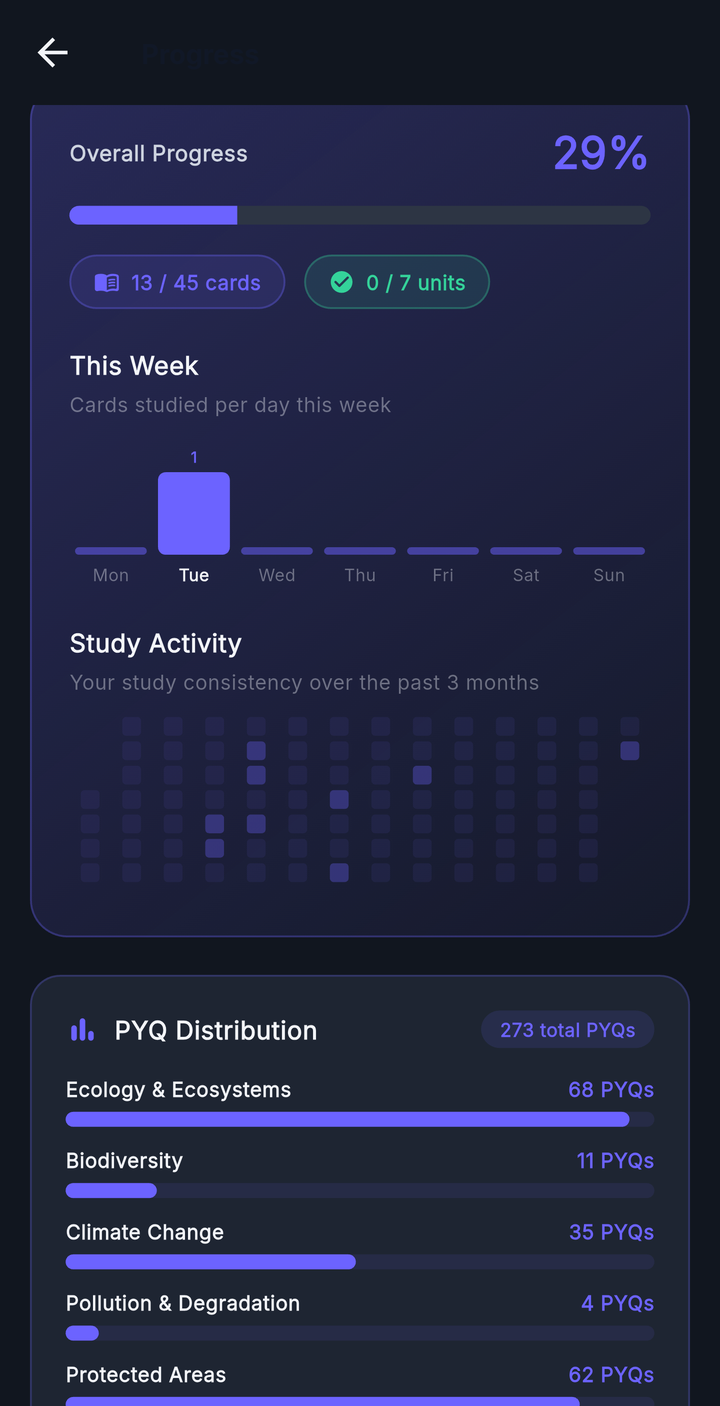
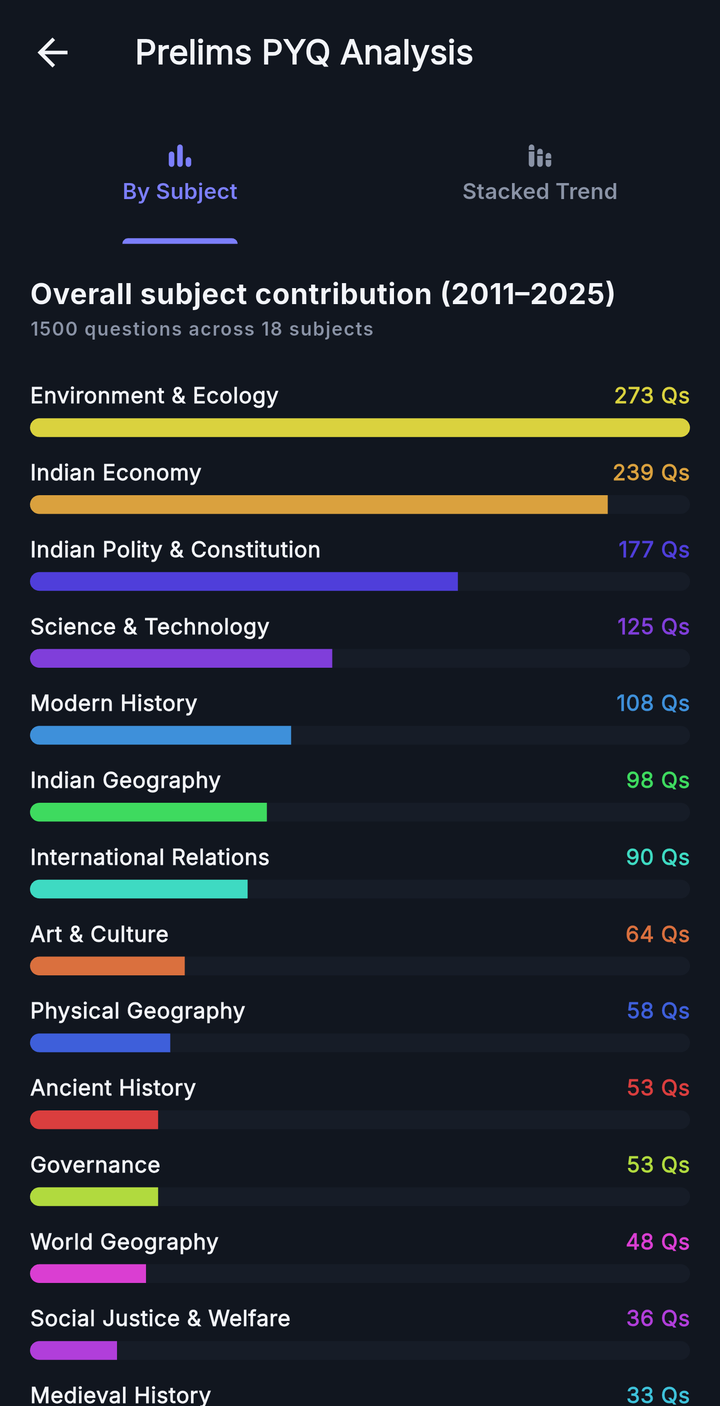
I analysed 15 years of UPSC Prelims PYQs and structured the syllabus from that signal. Every topic became a node — linked to cards, articles, quizzes, and PYQs. Progress is tracked at node level. The result: the syllabus becomes a live mastery map, not a static reading list.
Four tabs. One learning loop.
Each tab maps to a distinct phase of learning. Nothing overlaps. Every interaction in any tab feeds back into the mastery system.
Study → Recall → Practice PYQs → Diagnose gaps → Revise → Earn mastery.
— The loop every tab is designed around
Home (Dashboard)
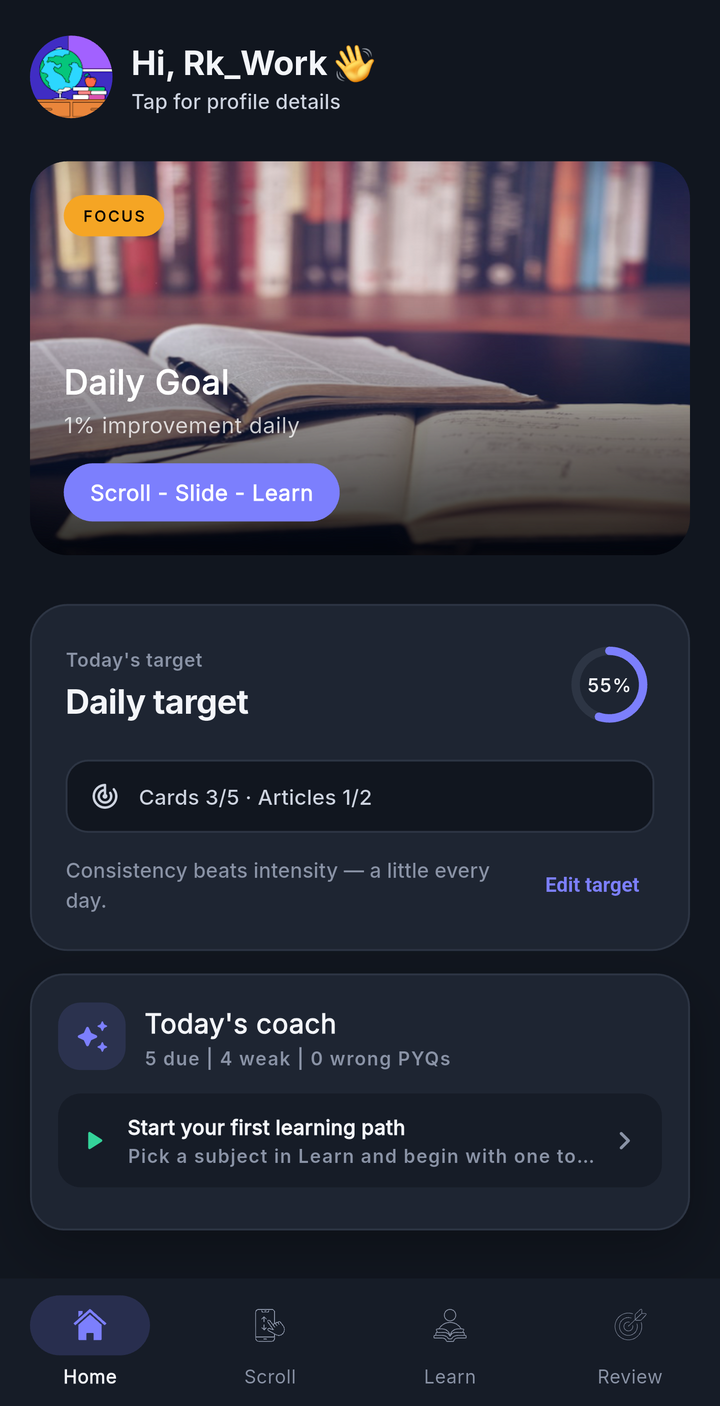
Your daily study coach. A personalized dashboard prompting you with exactly what to study today.
- Daily card goal ring & streak tracker
- "Falling behind" nudge banners
- Deterministic daily Card of the Day
- Trending decks list
Explore
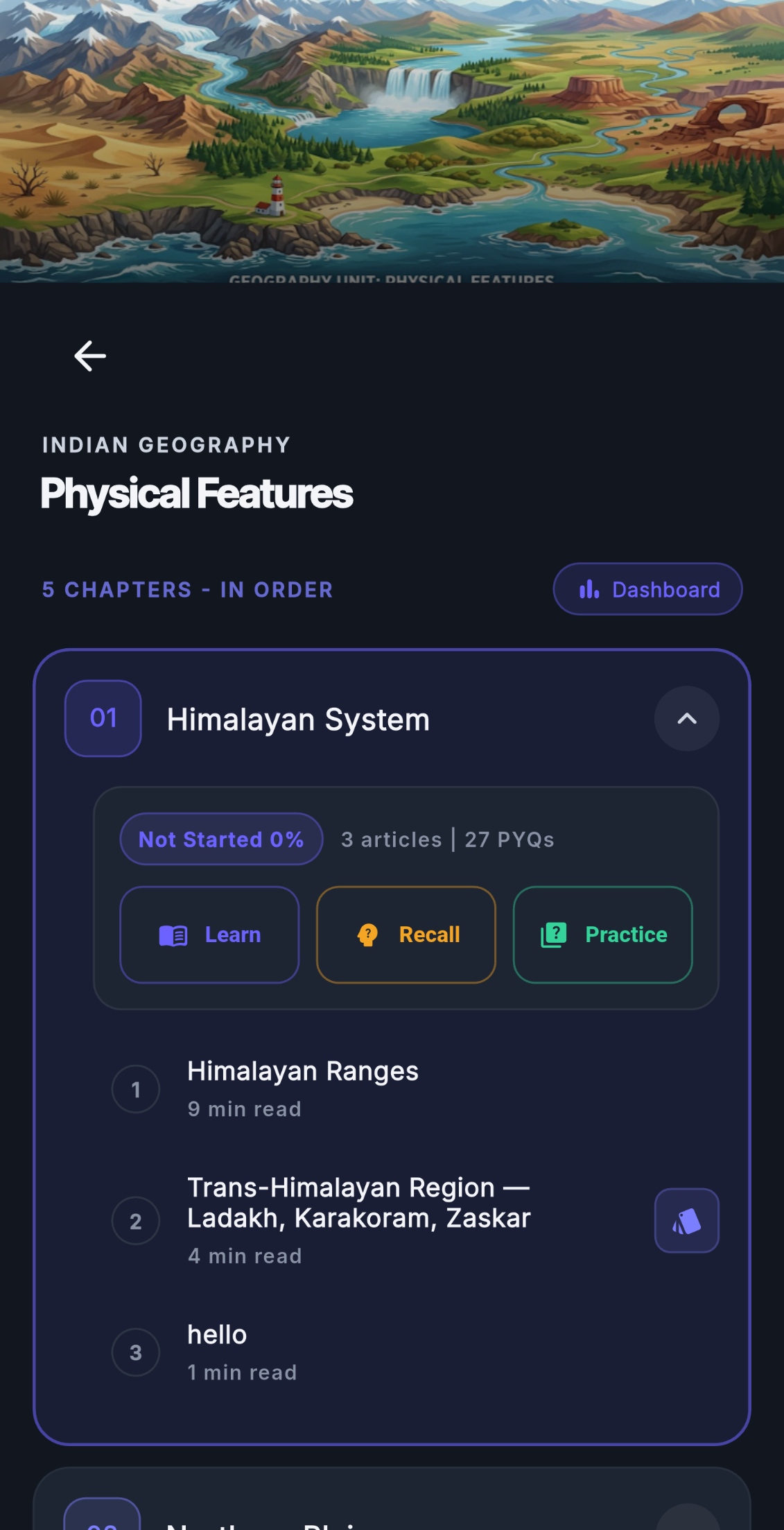
Your syllabus map. Browse content hierarchically from subject down to micro-topics and active decks.
- 16 Subjects (Polity, History, Geo...)
- Unit completion progress bars
- Spaced repetition due count indicators
- Direct access to cards, PYQs, and quizzes
Profile & Stats
Your progress record. A central hub tracking consistency, bookmarks, and gamified milestones.
- FCM notifications & settings
- Milestone streak badges (3d to 100d)
- Global XP ranking leaderboard
- Saved cards / bookmarks list
Swipe & Quiz
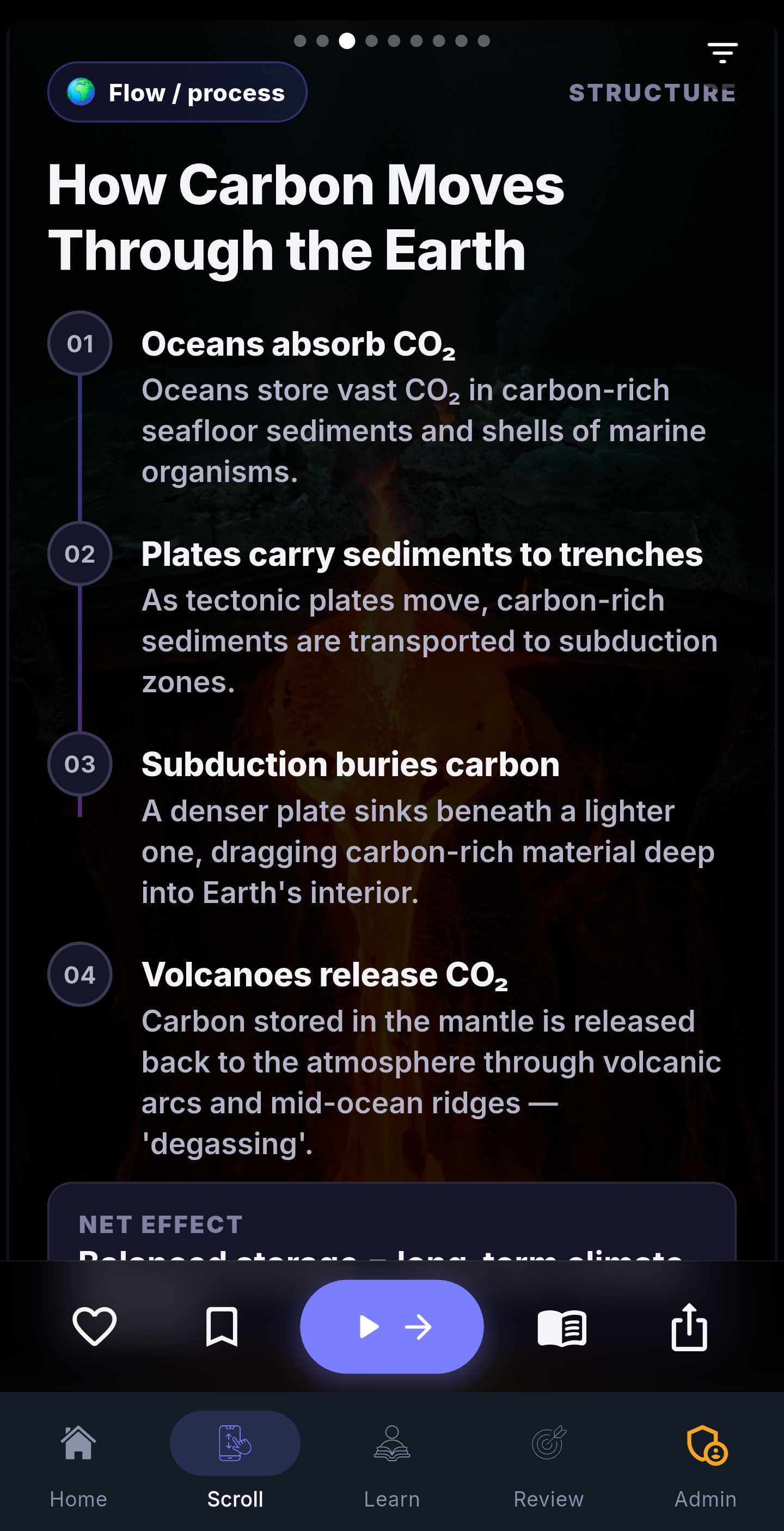
Active recall engines. Swipe visual cards to recall concepts, then test retention with quizzes.
- Vertical card swiper with audio TTS
- Hard / Medium / Easy active recall rating
- Gemini AI-generated MCQ quizzes
- Head-to-head friend challenge duels
What I chose not to build — and why that matters more than what I did.
The easiest product mistake is adding features. Every item below was considered, prototyped mentally, and deliberately rejected.
All AI-generated image cards
Visually rich but fragile at scale. One factual error requires a completely new image. No searchability as the card count grows. Switched to Flutter widget templates — accuracy, speed, and searchability together.
Active-Recall Gamification
Instead of cheap streaks that optimize for screen time, GyanGram uses a targeted XP system. Earn 5 XP for rating cards (Easy/Med/Hard) and 10+ XP for quiz completions. Milestone badges (3d to 100d) and a global leaderboard motivate daily consistency without distracting from deep work.
Contextual AI Quizzes
While generic mock test platforms offer random MCQs, GyanGram leverages Gemini AI to generate contextual quizzes directly from card content. Students get immediate feedback, score tracking, and detailed explanations to reinforce active recall alongside past exam questions (PYQs).
Threaded Peer Comments
Aspirants learn best together. Rather than a chaotic social chat, card comments are built as an academic discussion space. Students can clarify concepts, suggest mnemonics, ask doubts, or report errata right under the card, keeping conversations hyper-focused.
Text-based card templates over images
Searchability at scale. As cards reach thousands, students need to find specific topics instantly. Image cards are unsearchable. Flutter widget templates give full text search from day one.
JSON import for card decks
Speed of content creation without sacrificing structure. One structured JSON file generates an entire horizontal card deck in seconds. Reviewed and edited as needed. Content velocity without quality compromise.
Flutter for all platforms from day one
Android, iOS, web, and Windows from a single codebase. UPSC aspirants span urban smartphone users to desktop-first coaching students. No user excluded by platform choice from the beginning.
Launch after content seeding, not before
A content-first release means every early user gets a complete experience. Launching with skeleton content trains users to expect an incomplete product. Quality before reach.
One person. Design, tech, content, and systems — all of it.
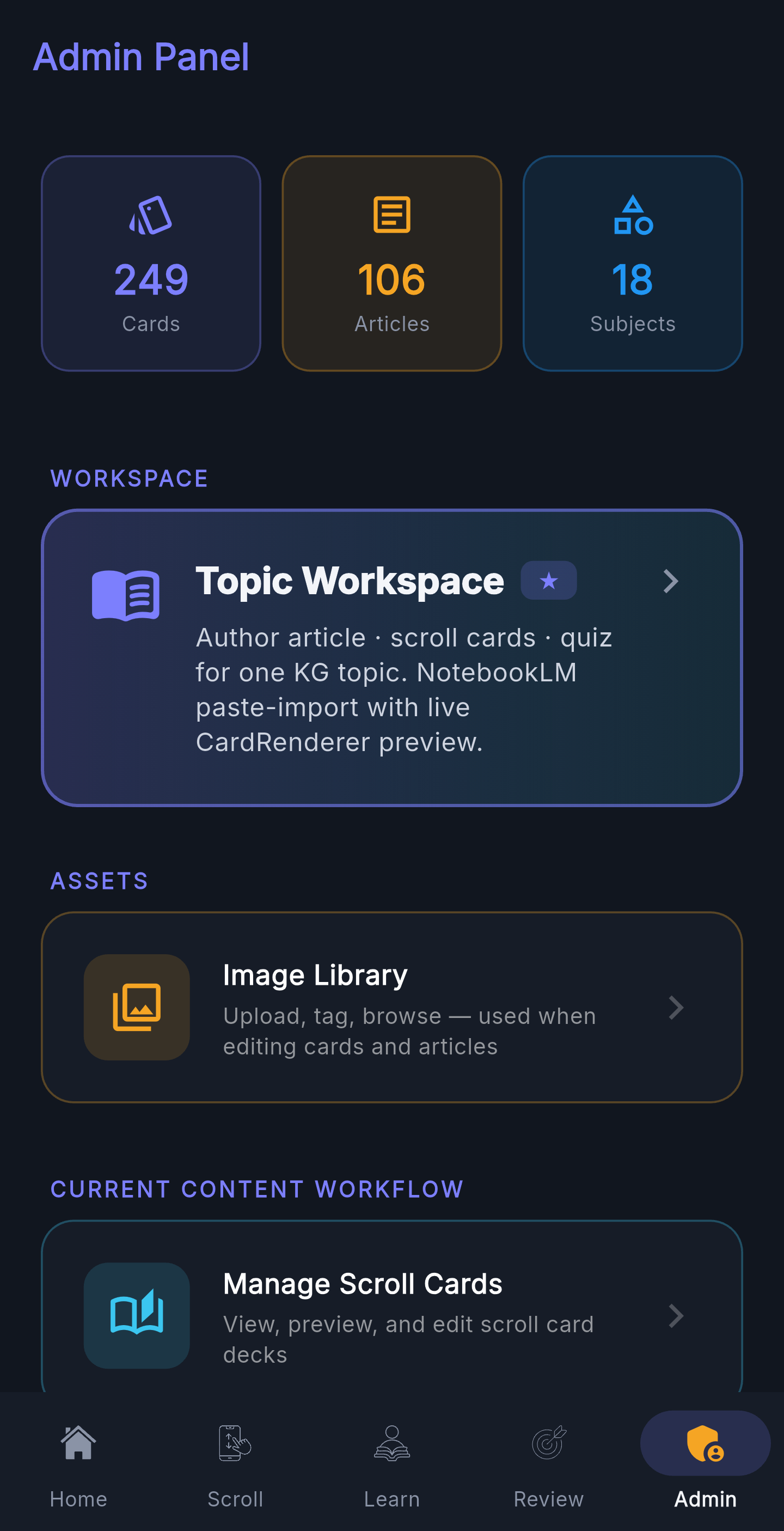
GyanGram is not a side project. It is a complete product operation: a design system, a content pipeline, an admin CMS, and a multi-platform application — built without writing traditional code, using AI-augmented development throughout.
The key philosophical constraint: AI as infrastructure, not as author. AI generates card visuals, assists with code, and speeds up structuring. But every factual claim, every PYQ explanation, every article is authored with six years of domain knowledge. Trust is the product.
Building a product solo forces every decision to be explicit — there is no PM to escalate to, no designer to delegate the hard trade-offs to. Everything in this case study was decided, owned, and executed by one person. The founder's six years of UPSC preparation (Prelims cleared 3 times across 5 attempts) is not a background detail — it is the user research that shaped every feature decision, every scope exclusion, and every content philosophy choice. That is a different kind of product experience than roadmap collaboration. It is closer to founding PM work.
Sequenced by user value, not feature count.
-
NowLive
Play Store & Web App Deployed
The core scroll → learn → review loop is fully live on Android and web with 1,600+ UPSC PYQs mapped across 16 subjects.
-
Month 1–3Next
Content Expansion
Expanding the seeded database to include current affairs and ethics card decks, keeping content fresh and highly aligned with the latest UPSC prelims trends.
-
Month 3–6Planned
Feedback-driven iteration
Refining card rendering performance, fixing image caching/pre-loading issues, and aiming for 10,000 active users before building additional features.
-
Year 1Planned
iOS App & Hindi Vernacular
Expanding native support to iOS devices and introducing Hindi language localization to assist vernacular medium UPSC aspirants.
-
LaterPlanned
Predictive AI Tutor
Deeper integration of LLM tools to dynamically assess personal knowledge gaps, predict weak areas, and generate highly targeted study recommendations.
Interested in GyanGram — as a user, collaborator, or as a PM case study?